How does endometriosis affect fertility?
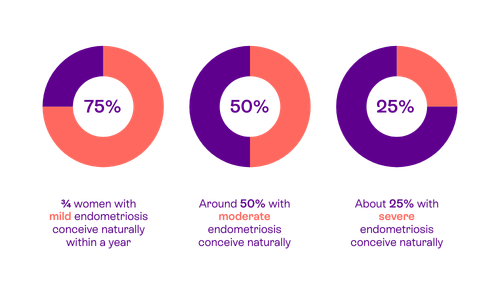
Endometriosis can make it harder to conceive by affecting the reproductive organs. For example, scar tissue may block the fallopian tubes, or inflammation can impact egg quality. However, not all women with the diagnosis of endometriosis have difficulty conceiving and many can conceive naturally. It is estimated that 30 to 50% of women who have difficulty conceiving after one year of regular sexual intercourse have the condition.
Chances of natural conception with endometriosis
Trying to conceive with endometriosis: Ashley’s story
Ashley has been living with endometriosis since she was a teenager. Years of painful, heavy periods left her bedbound at times, alongside hospital visits and surgery to remove the disease. She was often told it was just bad periods, but she knew it was more than that.
When Ashley and her husband Jason started trying for a baby, they hoped it would happen naturally. Instead, they faced years of waiting, setbacks, and heartbreak. With specialist support from Care Fertility Sheffield and a treatment plan built around her endometriosis, their journey took a different turn.
In this video, Ashley shares her story in her own words, from teenage symptoms to trying to conceive, and what life looks like now. Watch her story below, or read her full journey to follow every step in detail.
Understanding Endometriosis: a free guide
Endometriosis can be overwhelming, especially when it comes to understanding how it affects your fertility. That’s why we’ve created the Endometriosis Guide—a supportive, expert-led resource to help you make sense of it all. Inside, you’ll find clear information on symptoms, diagnosis, and treatment options, as well as guidance on how endometriosis might impact conception and what fertility treatments can help.
Whether you’ve just been diagnosed or have been managing the condition for years, this guide is here to reassure and empower you. Download your copy today—because you deserve answers, support, and a plan that’s right for you.

Endometriosis can feel overwhelming, but it doesn’t have to define your journey. At Care Fertility, we’re here to provide expert care, innovative treatments, and compassionate support. Together, we’ll work to overcome the challenges and help you move closer to achieving your dreams of better health and starting a family.

Diagnosing endometriosis
Endometriosis often goes undiagnosed, simply because it can be difficult to identify. Symptoms vary from person to person and can overlap with other conditions, which means in-depth investigations are sometimes needed to get clear answers.
But getting a diagnosis matters. It is an important step in understanding your symptoms, managing the condition properly, and knowing how it may be affecting your fertility.
Your doctor will take a detailed medical history, focusing on your symptoms, how severe they are, and how long they have been affecting you. They will also ask about your menstrual cycle, any difficulties trying to conceive, and whether there is a family history of endometriosis.
This helps build a clear picture of your overall reproductive health before moving on to further investigations.

A physical examination allows the doctor to check for signs that may be linked to endometriosis. This can include gently feeling the abdomen and pelvis for tenderness, masses, or other abnormalities.
In some cases, a pelvic examination may also be carried out. This involves the doctor examining inside the vagina with a gloved finger to assess for pain or changes around the womb and ovaries.

A pelvic ultrasound is usually performed as an internal vaginal scan. This allows us to assess the structure of the ovaries, uterus, and the area behind the womb.
While it can identify ovarian cysts linked to endometriosis, it does not always detect smaller endometriosis lesions. If symptoms continue, further imaging may be recommended.

An MRI scan may be recommended if there is concern about more advanced endometriosis, particularly affecting the bowel or bladder.
This type of scan provides detailed images of the pelvis and can help distinguish between endometriosis, adenomyosis, and fibroids. It is often used as a second-line investigation.
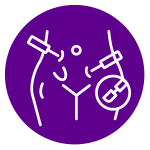
A laparoscopy is considered the gold standard for diagnosing endometriosis. It is a minimally invasive procedure that allows a surgeon to view the pelvic organs directly using a small camera.
This approach can confirm the presence and extent of endometriosis and, where appropriate, allow treatment or removal of affected tissue at the same time.

Join us for our Endometriosis & Fertility Event
If you’ve been diagnosed with endometriosis, or you think you might have it, and you’re starting to wonder what it means for your fertility, our specialist-led event is here to give you clear, honest answers.
Our fertility experts will explain how endometriosis can affect your chances of conceiving, talk through the treatment options available, and answer your questions in a calm, supportive space. It’s about helping you understand your body and your options, so you can take your next step with confidence.
Fertility treatment options for endometriosis
If you’ve been struggling to conceive naturally and have been diagnosed with endometriosis, there are plenty of options that can help. The type of treatment varies based on the severity of the condition and your fertility goals.
If you are living with endometriosis and unsure how it may be affecting your fertility, our pre-treatment fertility assessment bundle is a practical place to start.
These tests give us a clear picture of your ovarian reserve, womb, and overall reproductive health. A specialist will review your results with you and explain what they mean for your chances of conceiving.
It is about giving you clarity, so you can make informed decisions about your next step.
In vitro fertilisation (IVF) is often recommended for moderate to severe endometriosis, or where natural conception is less likely.
It may also be advised if there are additional factors involved, such as a blocked fallopian tube, low ovarian reserve, abnormal semen analysis, or advanced reproductive age.
In some cases, surgery may be needed before treatment begins. Your doctor will create a personalised plan based on your individual circumstances.
Intrauterine insemination (IUI) may be recommended in certain cases of endometriosis, particularly if you have mild to moderate disease and your fallopian tubes are open.
It can also be considered where there are additional factors, such as mild sperm concerns. IUI places prepared sperm directly into the womb around the time of ovulation, helping to shorten the journey to the egg.
For some people, this can be a supportive first step before considering more advanced treatment.
Managing endometriosis
Living with endometriosis can feel overwhelming, especially when symptoms affect your work, relationships, and plans for a family. While there is no one-size-fits-all treatment, there are options that can help reduce pain, control symptoms, and support your fertility goals.
Your care should always be tailored to you. Below are some of the approaches that may be recommended.
For some people, small lifestyle adjustments can help manage symptoms. This may include reducing certain foods such as dairy or wheat, and building in regular physical activity.
While diet and exercise will not cure endometriosis, they can support overall wellbeing and may help reduce inflammation and symptom severity for some individuals.
Pain relief medication can be used to manage symptoms, particularly during flare-ups or around your period. This might include over-the-counter painkillers or prescription medication recommended by your GP or specialist.
Managing pain effectively is important, not just physically but emotionally too, so you can continue with daily life as comfortably as possible.
Hormonal medications, such as tablets, coils, or injections, can help reduce or suppress the hormonal changes that cause endometriosis tissue to grow and bleed.
These treatments aim to control symptoms rather than cure the condition. They may also prevent symptoms from worsening over time.
Keyhole surgery can be used to remove or treat endometriosis lesions, including ovarian cysts and scar tissue. This may help reduce pain and improve fertility in some cases.
However, surgery on the ovaries, particularly for endometriosis cysts, can sometimes affect ovarian reserve. Your specialist will carefully weigh the benefits and risks before recommending this option.
In cases where symptoms do not respond to other treatments, and if you no longer wish to conceive, removal of the womb may be discussed.
This is considered a last-line treatment option and is only recommended after careful consultation and when other approaches have not provided relief.
Get in touch with us
If you’re concerned about how endometriosis may be affecting your fertility, speak to our team today. Call 0800 564 2270, or complete the form below and we’ll help you take the next step with clarity.
You might also find helpful

Endometriosis affects 1 in 10 women and AFAB individuals, though many go undiagnosed. Our blog explores key issues and fertility treatment options.
Read More

While endometriosis can affect fertility, our blog explains its impact and explores treatments to help you conceive.
Read More

Ashley and Jason began IVF in 2020 after three years of trying to conceive, with Ashley facing endometriosis and COVID-19 delays.
Read More