

SINGLE PARENT IVF
If you’re thinking about having a baby as a single woman, you’re not alone. More people are choosing to start families on their own, and there are clear, supported pathways to help you do that.
Single man looking to start a family? Learn more about surrogacy


Measures ovarian reserve to estimate how your ovaries may respond to treatment.


Assesses thyroid function, which plays a key role in fertility and hormone balance.


Checks levels linked to fertility, embryo development, and early pregnancy outcomes.

Measures ovarian reserve to estimate how your ovaries may respond to treatment.
Assesses thyroid function, which plays a key role in fertility and hormone balance.
Checks levels linked to fertility, embryo development, and early pregnancy outcomes.


Choosing a sperm donor is a personal decision, and there is no single way to approach it.
In the UK, sperm donors are not anonymous. Any child born from donor sperm can access identifying information about the donor when they turn 18.
You will be able to view a donor profile, including physical characteristics, medical history, and background information to help guide your choice.
We will support you through the process and answer any questions, so you feel confident in your decision.

The cost of donor sperm will depend on your treatment plan and how many samples are needed.
At Care Fertility, donor sperm from our own sperm bank starts from £1,380 per sample.
You may need more than one sample depending on your treatment, particularly with IUI where more than one cycle may be recommended.
We will talk you through expected costs early on, so you can plan ahead and make informed decisions about your treatment.
IUI is a simpler and less invasive form of treatment.
During IUI, prepared donor sperm is placed directly into the womb around the time of ovulation. This supports fertilisation inside the body in a way that is closer to natural conception.
IUI may be suitable if your fertility tests are reassuring and there are no known issues affecting your chances of conception.
Success rates per cycle are lower than IVF, so more than one cycle may be needed for treatment.

IVF is a more controlled and effective form of treatment.
During IVF, medication is used to stimulate the ovaries, eggs are collected, and fertilisation takes place in the lab using donor sperm to create embryos.
Embryos are monitored as they develop, and the strongest is selected and transferred to the womb for implantation.
Success rates per cycle are higher than IUI, and fewer cycles may be needed to achieve pregnancy.
Your chances of success
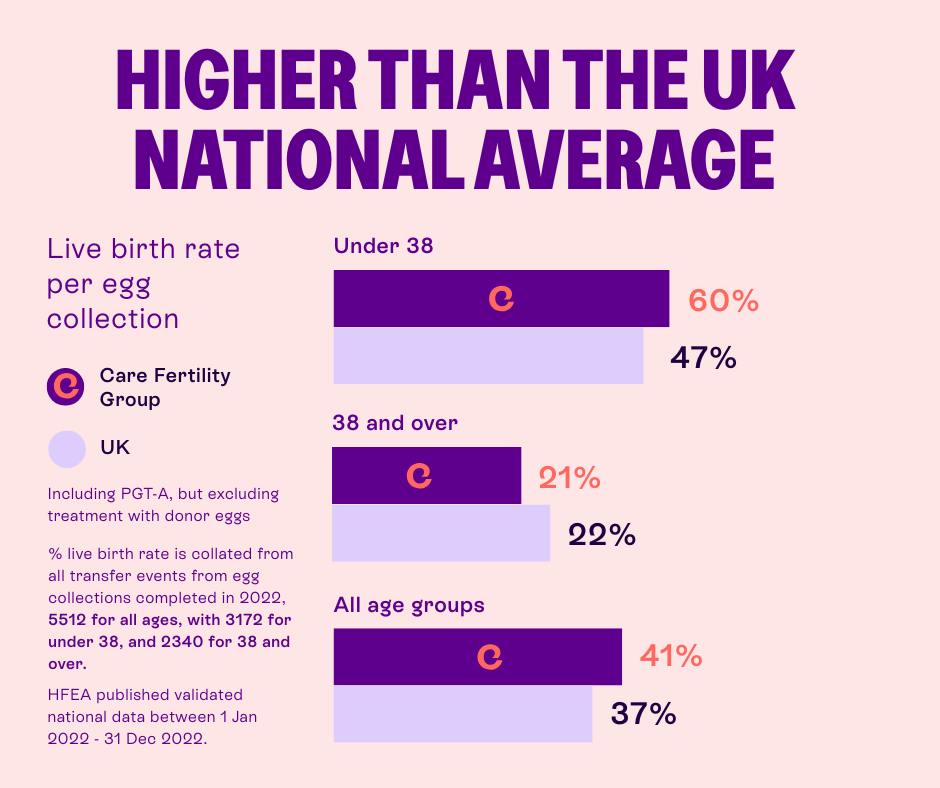
Our success rates are measured as live birth per egg collection, giving a clear picture of the chance of having a baby from treatment.
For women under 38 having IVF treatment, our group success rate is 60%, compared to a national average of 47%.
Success rates can vary depending on your age, ovarian reserve, and treatment plan. Some people conceive in their first cycle, while others may need more than one.
What matters most is understanding what these numbers mean for you.
What if you’re over 40?
Success rates change with age, particularly due to egg quality.
If you’re single and over 40, we’ve created a dedicated page that explains your options in more detail, including IVF, donor eggs, and ways to improve your chances.
View fertility treatment options over 40
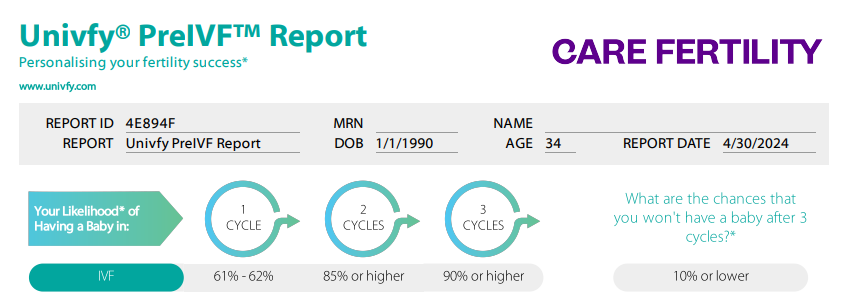
Univfy PreIVF report: personalised success rates
The Univfy PreIVF report gives you a personalised estimate of your IVF success before treatment begins.
It uses your clinical data, including your age, hormone levels, and medical history, to predict your likelihood of success across one or more cycles.
This helps you plan your treatment with a clearer understanding of what to expect, rather than relying on general averages.

Caremaps AI helps us assess how embryos develop to select the one most likely to succeed.
Embryos are grown in a time-lapse incubator and monitored continuously without being disturbed. This allows us to see their development in detail.
The AI is trained on millions of embryo images, helping identify patterns linked to implantation that may not be visible through standard checks.
Learn more about Caremaps Ai

PGT-A involves removing a small number of cells from an embryo to test its chromosomes before transfer.
Around 50% of embryos are aneuploid, meaning they are unlikely to lead to a successful pregnancy. This testing helps us identify and avoid these embryos.
By focusing on embryos with the correct number of chromosomes, we can improve success per transfer and reduce the risk of miscarriage.
Learn more about PGT-A
You might also find helpful

IVF can feel daunting, but we’re here to support you. This guide helps you prepare and choose the right path for your unique journey.
Read More
Wondering what fertility tests check for and what the results mean? We’ll explain every step to help you understand your unique journey.
Read More
IVF costs vary based on your needs and treatment type. At Care Fertility, we make costs clear, helping you feel in control as you plan your journey.
Read More