

IVF FOR OVER 40'S
Trying for a baby over 40? We’ll help you understand your options.
Fertility changes with age, but you still have choices. At Care Fertility, we start with tests, talk you through your results, and help you understand which treatment options may give you the best chance.

Egg quantity refers to how many eggs remain in your ovaries — your ovarian reserve.
Even if you’re having regular periods, ovarian reserve can still be reduced.
We assess this using:
- AMH (Anti-Müllerian Hormone): indicates how many follicles may be available
- Antral follicle count (AFC): shows how many small follicles are visible on scan
These results help us estimate how your ovaries may respond to stimulation during IVF.
For example:
- Lower AMH → fewer eggs may be collected
- Higher AMH → more eggs may be collected

Egg quality is closely linked to age.
As egg quality declines:
- Fewer eggs fertilise normally
- More embryos stop developing before day 5
- More embryos have chromosomal differences (aneuploidy)
- Implantation rates are lower
This is why two people with the same AMH can have very different IVF outcomes.
A simple way to explain it:
- Quantity affects how many embryos we can create
- Quality affects how many embryos can lead to a pregnancy


Measures ovarian reserve to estimate how your ovaries may respond to treatment.


Assesses thyroid function, which plays a key role in fertility and hormone balance.


Checks levels linked to fertility, embryo development, and early pregnancy outcomes.


Measures ovarian reserve to estimate how your ovaries may respond to treatment.
Assesses thyroid function, which plays a key role in fertility and hormone balance.
Checks levels linked to fertility, embryo development, and early pregnancy outcomes.
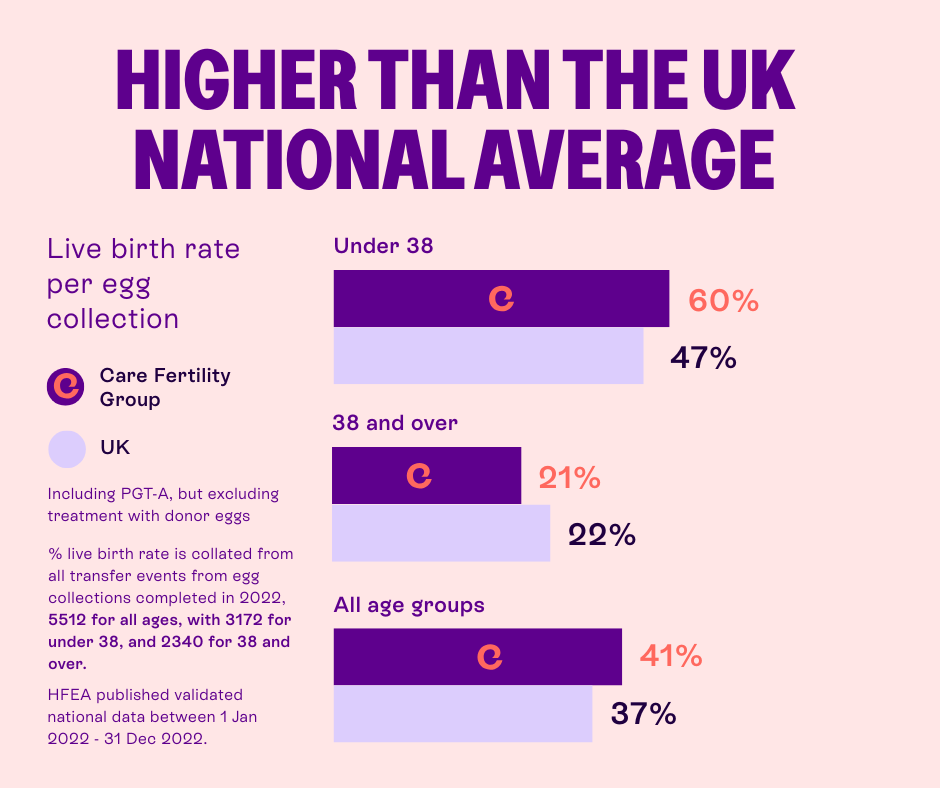
Success rates for patients aged 38+
Success rates using your own eggs decline with age, mainly due to changes in egg quality.
It’s also important to understand how success rates are measured. Some are based on cycles started, while others are based on embryos transferred. These differences can affect how results are interpreted.
The Human Fertilisation and Embryology Authority (HFEA) groups national IVF data by age bands. This means that patients aged 40 and above are included within the 38+ age group in reported success rates.
Because of this, published figures for 38+ include a range of ages, and outcomes for those in their early 40s may differ from the overall average.
For patients using donor eggs, success rates are typically higher, as they're linked to the age of the donor rather than the age of the patient. If this is something you're weighing up, our guide to donor egg treatment walks through how it works, how donors are matched, and what to expect, so you can decide whether it's a path you'd like to explore further.
Click here to view detailed success rates
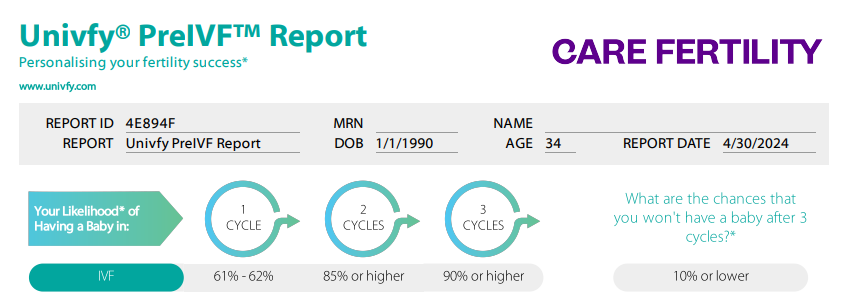
Univfy PreIVF report: personalised success rates
Success rates provide a general guide, but they don’t reflect your individual circumstances.
The Univfy PreIVF report uses your clinical data, including your age, AMH levels, and medical history, to estimate your likelihood of success with IVF before treatment begins.
This can help you understand your chances across one or more cycles and plan your treatment with more confidence.
It’s a personalised prediction tool designed to support decision-making at the start of your journey.
Learn more about the Univfy PreIVF report

IVF allows sperm and egg to meet naturally in the lab.
After egg collection, sperm is added to each egg and fertilisation happens without intervention. The resulting embryos develop over several days before one is selected and transferred to the womb.
This may be recommended when both egg and sperm quality are suitable for natural fertilisation.
Learn more about IVF packages

ICSI is a form of IVF where a single sperm is injected directly into each egg.
You’ll take medication to stimulate the ovaries, eggs are collected, and fertilisation is supported in the lab using this technique. The strongest embryo is then transferred to the womb.
This may be recommended if sperm quality or previous fertilisation outcomes could affect success.
Learn more about ICSI
This approach changes where the egg or sperm comes from.
Embryos are created using donor eggs or donor sperm, rather than your own, and then transferred to the womb. The process is similar to IVF, but the focus is on improving outcomes through donor gametes.
This may be recommended when egg or sperm quality is affecting your chances of success.

Caremaps AI helps us choose the embryo with the best chance of success. Embryos are grown in a time-lapse incubator, where they’re continuously monitored without being disturbed. This protects their environment and gives us a complete view of how they develop.
The AI has been trained on millions of embryo images, helping identify patterns linked to implantation that aren’t always visible through standard checks.
For patients over 40, where fewer embryos may be available, this extra insight helps us make more informed decisions about which embryo to transfer first.
Learn more about Caremaps Ai

PGT-A involves removing a small number of cells from an embryo to test its chromosomes before transfer.
Around 50% of embryos are aneuploid, meaning they’re unlikely to lead to a successful pregnancy. PGT-A helps us identify and avoid these, so we can focus on embryos with the best chance.
For patients aged 38 and over, PGT-A helps identify embryos most likely to succeed, though the HFEA says evidence for improving birth rates at this age isn't yet strong. It's better supported for reducing miscarriage risk, which is often why patients choose it.
Learn more about PGT-A
You might also find helpful

Over 40 and considering IVF? Age isn’t a barrier! Discover personalised treatments and support to make your family dream a reality.
Read More
Learn about IVF success rates and what they mean for your journey. Understand the facts to plan confidently for your path to parenthood.
Read More
IVF costs vary based on your needs and treatment type. At Care Fertility, we make costs clear, helping you feel in control as you plan your journey.
Read More