
If you’re thinking about fertility treatment, it’s completely normal to want clearer answers. You might be asking yourself what your chances look like, how many cycles you may need, or whether now is the right time to move forward.
While no test or tool can give 100% certainty, new advances in data and AI are helping us build a more detailed picture of your individual fertility.
Tools like the Univfy Pre IVF Report and Violet AI use information from thousands of real treatment journeys to provide personalised insight. Instead of relying on broad averages, they help us understand how people with similar profiles have responded to treatment — giving you more meaningful information to guide your next steps.
It’s about moving from general statistics to something that feels more relevant to you, your body, and your plans.
Quick Jump:
How AI works in fertility care
AI tools are trained on large datasets. In fertility, this includes thousands of previous treatment cycles, outcomes, and patient characteristics.
This data might include:
- Age and medical history
- Hormone levels such as AMH
- Scan results, including follicle counts
- Details from previous IVF or egg freezing cycles
- Embryology data, such as egg or embryo development
The AI learns patterns from this data. It looks at how similar profiles have responded to treatment in the past.
When your data is entered, the system compares your results against these patterns. It then calculates the most likely outcomes based on what has happened in similar cases before. It’s not guessing, it’s identifying where your profile fits within a much larger picture.
Univfy Pre IVF Report: using data to predict your chances
The Univfy Pre IVF Report is used as part of your consultation to provide a personalised estimate of your chances of success with IVF.
Rather than relying on general statistics, this report uses your individual clinical information to create a prediction that reflects your specific situation.
How it works
The Univfy Pre IVF Report is built using large datasets from previous IVF cycles, including patient characteristics, treatment pathways, and outcomes collected across multiple clinics.
Once your fertility tests have been completed and reviewed, your data is entered into the model. This typically includes factors such as your age, diagnosis, hormone levels, and other relevant clinical information gathered during your assessment. As with all Care Fertility pathways, these tests are completed before your consultation so your doctor can talk through your results and what they mean for you in detail.
The system then analyses this information by:
- Comparing your profile with patients who have similar characteristics
- Identifying patterns in how those patients responded to treatment
- Calculating a personalised probability of achieving a live birth over a set number of IVF cycles
The output is presented as a range, reflecting the natural variation seen in real-world outcomes.
What this means for you
IVF success rates are often presented as averages, usually grouped by age. While helpful at a population level, these figures do not account for the full picture of an individual’s fertility.
The Univfy Pre IVF Report provides a more tailored estimate based on data from patients with similar clinical profiles. This allows for a more informed and relevant discussion during your consultation.
It supports clearer decision-making by helping you understand:
- Your estimated chance of having a baby over one or more IVF cycles
- How your individual factors may influence those chances
- What your potential treatment pathway could look like
This information is discussed with your doctor during your consultation, alongside your test results and medical history. Following your appointment, you will receive a summary of your consultation, including recommended next steps and cost estimates, through your companion app, so you have everything you need to reflect and decide what feels right for you.
What a report looks like
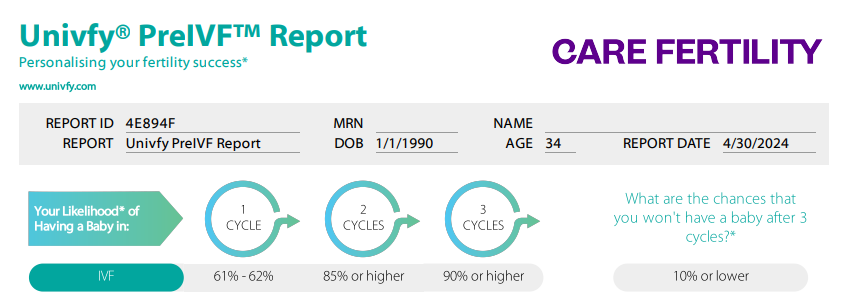
The report presents your predicted likelihood of having a baby across one, two, and three IVF cycles.
In the example shown:
- After one cycle, the estimated chance is 61–62%
- After two cycles, this increases to 85% or higher
- After three cycles, the likelihood rises to 90% or higher
Alongside this, you’ll also see a figure showing the likelihood of not having a baby after three cycles, which in this case is 10% or lower.
This format is designed to give a clearer picture over time. IVF is often not a single-step process, and success rates can increase across multiple cycles.
Violet AI: using data to assess egg quality
Violet AI is used in egg freezing cycles to support how we assess eggs. It gives our embryology team an extra layer of insight, helping guide decisions around which eggs are most suitable for freezing.
How it works
Violet AI has been trained on large image datasets of eggs and their outcomes.
These datasets link what an egg looks like with what happened next, including:
- Whether the egg survived freezing and thawing
- Whether it developed into a blastocyst (an embryo at day 5–6)
- The likelihood of that embryo being euploid (chromosomally normal)
When your eggs are collected:
- High-resolution images are taken in the lab
- Violet AI analyses each egg in detail
- It compares your eggs to thousands of others in its dataset
- It identifies visual patterns linked to stronger outcomes
This all happens quickly, alongside the work your embryologist is already doing.
Understanding blastocysts and euploidy
Blastocyst potential
A blastocyst is an embryo that has developed over around five days. Not every egg will reach this stage. Eggs that do are more likely to continue developing and have the potential to lead to pregnancy.
Think of it like planting seeds — not every seed sprouts, but those that do are the ones with the best chance of growing further.
Euploidy (chromosomally normal embryos)
A euploid embryo has the right number of chromosomes. This matters because embryos with missing or extra chromosomes (called aneuploid) often won’t implant or may lead to miscarriage.
While we can’t see chromosomes just by looking at an egg, Violet AI has been trained to recognise visual patterns that are often linked to a higher chance of producing euploid embryos later on.
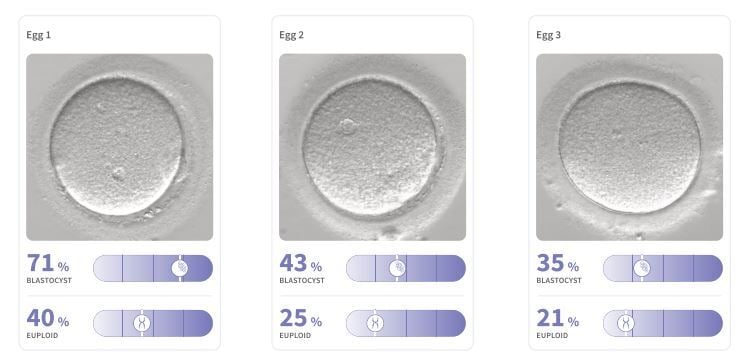
In the example shown:
- Egg 1 shows higher predicted chances of reaching the blastocyst stage (71%) and being euploid (40%)
- Eggs 2 and 3 have lower predicted probabilities
What this means for you
Eggs can look very similar under a microscope. Even for experienced embryologists, some differences are too subtle to spot by eye.
Violet AI helps by:
- Highlighting patterns we might not otherwise see
- Supporting decisions about which eggs to freeze
- Adding another layer of reassurance to the process
It’s important to say — this doesn’t replace expert judgement. Your embryologist is still at the centre of every decision. AI simply adds more information to work with.
A more informed approach to egg freezing
Choosing to freeze your eggs is a big step. Understandably, you want to know you’re giving yourself the best chance for the future.
Tools like Violet AI help us make those decisions with more confidence, using both human expertise and data-driven insight — working together, not one instead of the other.
And as always, we’ll talk you through what everything means for you, in a way that’s clear and grounded in your individual situation.
Why large datasets matter
The strength of both tools comes from the scale of data behind them.
The more data the system has:
It’s like building a clearer picture over time. Each additional data point helps refine the model and improve how it matches new patients to past outcomes.
How AI fits into your care
AI is one part of a wider clinical process.
Your journey still starts with fertility testing. We carry out blood tests, scans, and semen analysis where needed, so we understand your fertility before your consultation.
Your doctor then reviews your results and talks you through your options. Tools like Univfy Pre IVF Report can support this discussion with personalised predictions.
After your consultation, you’ll receive a summary of your results, treatment options, and costs through your companion app. If you decide to move forward, you’ll complete viral screening blood tests and consent forms before attending a treatment planning appointment with a nurse.
If egg freezing is part of your plan, Violet AI may be used later in the process when your eggs are collected and assessed.
The bottom line
Both the Univfy Pre IVF Report and Violet AI use large datasets to compare your individual profile with thousands of previous cases.
They identify patterns, match your data to patients with similar characteristics, and estimate likely outcomes based on real-world evidence.
They don’t replace clinical expertise, but they do give your care team more information to guide decisions and tailor your treatment.
For you, that means clearer insight, more personalised guidance, and a better understanding of your options.
If you’d like to explore what this could mean for you, our team is here to help. Call us on 0800 564 2270 or get in touch online to speak with one of our fertility specialists.
-1.png?width=290&name=HFEA%20National%20Average%20(3)-1.png)