
Artificial intelligence (AI) is beginning to change how people plan their fertility journeys and how clinicians harness information to support your treatment decisions.
From predicting IVF success rates to supporting embryo selection in the lab, AI tools are helping fertility specialists analyse large volumes of data and identify patterns that can support more personalised care.
For patients, this may help answer important questions earlier in the journey. Questions such as: What are my chances of success? Should I start treatment now? Which embryo is most likely to lead to pregnancy?
Technologies such as Univfy Pre IVF Report, Caremaps AI, and Violet AI are already being used within fertility care to support patients and clinicians at different stages of the process.
Quick jump:
Why AI is becoming important in fertility care
Fertility treatment produces a large amount of clinical data. Hormone levels, ultrasound scans, egg numbers, sperm quality, embryo development, and pregnancy outcomes all contribute to understanding how treatment progresses.
When analysed across thousands of treatment cycles, this information can reveal patterns associated with successful outcomes.
AI systems are designed to process these large datasets and identify relationships between clinical factors and treatment results. This allows clinicians to use evidence from many previous cases when supporting treatment decisions.
In fertility care, AI can help:
- analyse treatment outcomes across large populations
- identify factors linked to higher success rates
- support embryo selection in the laboratory
- assist clinicians when discussing personalised treatment options
For patients, this contributes to more informed decision-making and clearer expectations about treatment.
Univfy Pre IVF Report: predicting personalised IVF success rates
One of the most common questions people ask before starting IVF is about their likelihood of success.
General IVF statistics provide useful context, but individual factors can significantly influence outcomes. Age, hormone levels, previous pregnancies, and underlying fertility conditions all play an important role.
Univfy Pre IVF Report uses machine learning models trained on a massive, quality data set from all our clinics. If you are using your own eggs and on your first cycle with us the Univfy Pre IVF Report can provide a more accurate estimation of your chance of a successful outcome when proceeding with IVF treatment at Care Fertility. Matching your personalised circumstances to other patients in our historic data to understand your likelihood of having a baby from IVF treatment.
The system analyses factors such as:
- age
- Anti-Müllerian hormone (AMH) levels
- previous IVF history
- fertility diagnosis
- planned treatment approach
Using this information, the platform produces a personalised estimate of the likelihood of having a baby across one or more complete IVF cycles, which includes the egg collection and all transfer events.
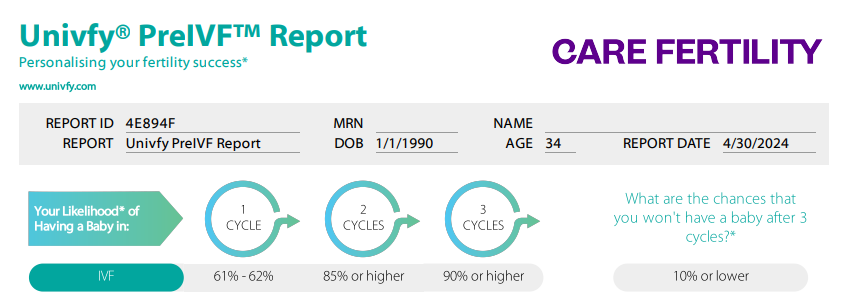
These predictions support discussions between patients and clinicians about treatment planning. They can help patients understand possible outcomes and consider their options with more clarity. It can help you understand that you are not alone as you can see others with similar circumstances to yours.
It is important to remember that predictions cannot guarantee results. Fertility treatment involves complex biological processes, and outcomes vary between individuals.
Learn more about the Univfy Pre IVF report
Caremaps AI: supporting embryo selection in IVF
Embryo selection is one of the most important stages of IVF treatment.
After fertilisation, embryos develop in the laboratory for several days before the embryology team selects the embryo most suitable for transfer.
Embryologists traditionally assess embryos based on appearance or morphology and development during this period.
Caremaps AI adds further analysis by reviewing thousands of time-lapse images collected during embryo culture and comparing them with historical image datasets where outcomes are known.

The system identifies developmental patterns associated with live birth outcome and generates a score that indicates the probability of an embryo leading to a baby.
Embryologists then use this information alongside their expertise when making embryo selection decisions.
At Care Fertility, technologies such as Caremaps AI support the work of experienced embryologists rather than replacing clinical judgement. Each embryo is still carefully reviewed by specialists, and decisions consider the wider clinical context.
The aim is to provide additional information that may help identify embryos with greater potential of becoming a baby.
Violet AI: supporting fertility awareness and early decision-making
AI is also being used to support people before they begin fertility treatment.
Violet AI focuses on fertility preservation and planning. The platform analyses images taken of eggs (oocytes) prior to cryopreservation for fertility preservation.
This technology provides insights around the complete set of eggs frozen:
- individual egg quality
- prediction of number of blastocyst possible
- potential live births
- supporting discussions on next steps
For many people, the challenge is understanding the potential of the eggs in storage for you. Tools like Violet AI provide additional information otherwise unavailable to help support decisions on when to start a family.
Below is an example of how Violet AI presents insights from your frozen eggs. It uses imaging and data analysis to estimate the likelihood of each egg developing further.
The report breaks things down clearly, so you can see:
- Chance of reaching blastocyst stage
This is the likelihood of an egg developing into a blastocyst — the stage where an embryo is ready for transfer. Think of it as how far each egg might go in the journey. - Chance of being euploid
This looks at whether an embryo is likely to have the correct number of chromosomes. Euploid embryos are more likely to lead to a successful pregnancy.
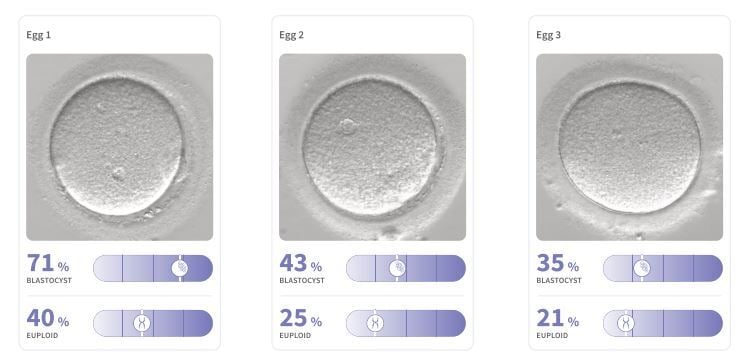
At Care Fertility, we encourage the use of technology to enhance our understanding and Violet provides information on your chance of success from oocytes saved for the future, providing information on the chance of having a live birth if you return to use these eggs in the future.
Learn more about Violet AI and egg freezing
The future of AI in fertility treatment
AI in fertility medicine continues to develop as more treatment data becomes available.
Potential applications in the future may include:
- more personalised treatment protocols
- improved embryo selection models
- earlier identification of fertility challenges
- more precise prediction of treatment outcomes
These developments may help clinicians tailor treatment approaches more closely to each individual patient.
Combining technology with expert fertility care
AI technologies such as Univfy Pre IVF Report, Caremaps AI, and Violet AI represent a growing shift towards data-driven fertility care.
By analysing large volumes of clinical data, these tools can provide insights that support treatment planning, embryo selection, and fertility awareness.
However, fertility treatment will always rely on expert clinical judgement and compassionate care. AI supports the decision-making process, but the most important guidance still comes from experienced fertility specialists who understand each patient’s unique circumstances.
The goal is to combine advanced technology with expert care to support people on their path to building a family.
Ready to take the next step?
Book a fertility assessment with us today. We’ll carry out your tests first, then walk you through your results and options in a consultation—so you can move forward with confidence, knowing exactly where you stand.
Get in touch with our expert team today by clicking here or calling 0800 564 2270.