
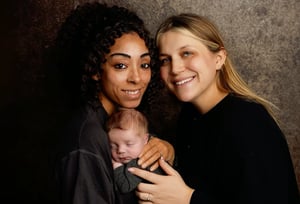
At Care Fertility, we believe everyone deserves clear, compassionate fertility support, whatever their path to parenthood looks like. That’s why we’re proud to partner with the PFA, helping players access trusted fertility information, expert guidance, and care that fits around their lives, careers, and future plans.
As part of this partnership, former goalkeeper and PFA women’s football and EDI lead Fran shares her story with her partner Jess and their little boy, Reuben. From trying to understand their options as a same-sex couple, to finding the right donor and having IUI treatment at Care Fertility Leeds, Fran speaks honestly about the questions, waits, surprises and little moments that shaped their journey.
Her story is a reminder that fertility planning doesn’t have to mean starting treatment straight away. Sometimes, it simply means understanding where you are, knowing what support is available, and feeling able to make decisions in your own time.
Click here to watch Fran's story, or keep reading below:
I’m Fran. I work for the PFA in the women’s football department and EDI, and I’m a former goalkeeper. Thinking about it now, I played for Chelsea, Liverpool, Crystal Palace and Sheffield United. I’ve been working at the PFA for two years now.
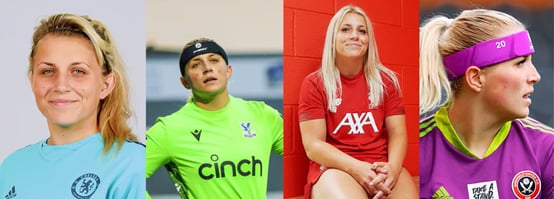
Fran’s football career took her to clubs including Chelsea, Crystal Palace, Liverpool and Sheffield United before she joined the PFA.
When I was playing, I don’t think I really thought about family planning as much as maybe I do now. But deep down, I always knew I wanted a family. I also knew I didn’t want to play until I was 36. So, when I got to a point in my career where I wasn’t really enjoying football anymore, starting a family felt like the next step for me and my partner, Jess.
At the beginning, we had no idea where to start. We had a teammate who worked at Care Fertility Leeds, and she was the one who first told us about the options we had. Before that, we went to the doctors and it was quite embarrassing, really, because they had no idea what we were even asking.
We were saying, “Well, we want a family,” and they didn’t know the procedure for same-sex couples. So, it was exhausting, trying to explain what we wanted and not really getting any answers back. The doctor was great, but it was almost education for her as well, not just around same-sex couples, but around anyone wanting a referral for fertility support.
If we hadn’t had that direct contact, I don’t think we would have known where to start. Even Google wasn’t that helpful. We didn’t know you could get NHS funding, or that you had to meet certain criteria, or how to access any of it. In the end, we did get NHS funding thanks to our friend and former teammate Sophie Walton, explaining the process at Care Fertility Leeds but even understanding the process felt like a minefield and if it wasn’t for her, we’d have paid out thousands of pounds without needing to!
“Turns out Jess was more fertile than me”
The reason we started looking into fertility was because Jess is a little bit older than me. She’s eight years older, so we were thinking, “How much time have we got? Do we need to be looking at this now?”
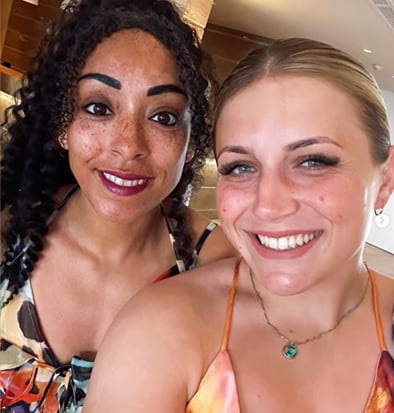
Fran and Jess began exploring their fertility options after realising they wanted to start a family together.
And then it turns out Jess was more fertile than me. She’s a little superwoman. Her results were amazing, like she could be 16 fertility-wise. Mine were still normal, but we’d always presumed that because I was younger, I’d be more fertile. That just wasn’t the case.
That was a big thing for me. You just don’t know what’s happening in your body until you have the tests. You can’t guess it because someone is older, or younger, or because they look fit and healthy. Every single person is different.
For us, that first appointment helped us understand where we were. It looked at eggs and follicles and things like that, and it helped us know whether we needed to start planning now, or whether we still had time in the future before maybe needing to freeze eggs or look at other options.
But Jess had eggs to throw away and give out, basically. So, we started the process.
Finding a donor took a year
It was actually a long time after that appointment before we had Reuben, for lots of different reasons. The biggest one was finding a donor.
Jess is white British Caribbean, and we wanted the donor to be the same. There is such a shortage. When we spoke to Care Fertility, they told us there’s a real shortage of donors from ethnic backgrounds, and we really saw that. You’d put in mixed heritage, and it would come up with white and Chinese or white and Malaysian, but there was a real lack of Afro-Caribbean donors.
Jess has actually considered donating her eggs for any couples going through this process and in the same position as us, given that we have felt firsthand how it feels to struggle searching.
From the point of us starting that search, it took about a year to find a donor. Being ready to have a baby and then not being able to have one because of that was hard. It was a full year of just checking and checking. Then one popped up, and we started the process.
“We just presumed it would be IVF”
When people talk about fertility treatment, the only thing that’s commonly known is IVF. So straight away, we just presumed that’s what we’d be having.
But we didn’t have IVF. We had IUI, where they don’t actually extract the egg. The egg stays in, and they go with your ovulation cycle. It’s less invasive, and if all your tests show everything is working as it should, it can be offered to you.
That was all explained to us, which made such a difference. We had gone in thinking fertility treatment meant this big journey of taking the egg out and processing everything, and actually there was an option that suited us better.
Talking about the donor
We also had counselling, which is compulsory when you’re using a donor. It’s about the practicalities of having a donor, what your child can access in the future if they want to know who their donor is, and how you navigate those conversations with them. How do you explain why they don’t have a dad, as such? How do you talk about that journey?
That was a real key part for us. It made us think, “Right, how does that make us feel? Are we OK with that?”
For us, the donor is a donor. He’s not Reuben’s dad. He’s someone who wanted to help someone else have a family. Reuben might want to reach out to him in the future, and that’s his choice if he does. There’s also nothing to say the donor would want anything to do with him in that way, which is fine as well. But we had to think about it properly, and counselling helped us do that.
Any questions we had were always answered. It was never like, “You’ve had your consultation, you can’t ask anything now.” We could ring up at any point and clarify anything we needed. Even recently, Care Fertility reached out to ask if it had been a positive pregnancy and whether there was anything else they could do to support us. We were just over the moon to say we’d actually had a baby through them.
The Sheffield United bus
I always remember the day I had to ring the clinic.
With IUI, you test for ovulation. There’s a smiley face on the test, and when it’s flashing, you’re getting closer to ovulation. When it’s solid, that’s when you need to ring.
I was on a bus full of men going to the Sheffield United play-offs at Wembley with my dad and Jess. We stopped at the services, and I thought, “Right, I’m going to do a test just to see.” And it went solid.
So I’m on this bus full of men, on the way to the Sheffield United play-offs, and I need to ring Care Fertility. I rang them, and the woman on the phone was saying, “Sorry, I can’t hear you, I can’t hear,” because all the men were chanting Sheffield United songs.
I should have rung on the way back, because it was silent then. They lost.
But I’ll always remember that. I was on the bus thinking, “I’m ovulating, I need to ring up right now.” The next day, we went in and had the procedure done. Maybe Reuben will end up a little Sheffield United fan when he’s older. I feel like he could be forced into that.
The two-week wait
After the treatment, it became that thing of ticking off the next step, week by week. You have the treatment, then two weeks later you test, then maybe you have an early scan. You’re literally working week by week to what the next thing is going to be.
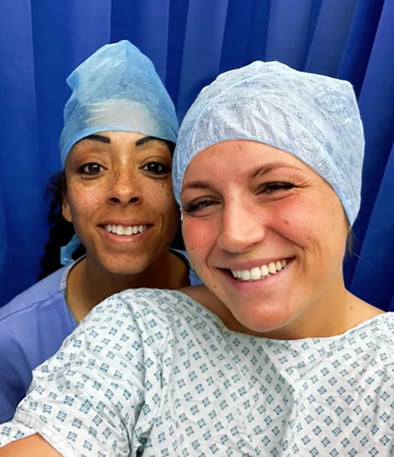
Fran and Jess at Care Fertility Leeds, where they were supported through IUI treatment using donor sperm.
For people going through fertility treatment, it’s not guaranteed it’s going to work. That’s why one of the things I really liked about Care Fertility was that they don’t just publicise couples with babies everywhere. It’s about the couples, because there is no guarantee. If you’re struggling, and you’ve tried and tried, you don’t always want to sit there looking at a poster of someone holding a baby. That was something I’d never really thought of before, but it really helped at the time.
The clinic felt welcoming, like everybody was there for the same thing, and that’s for a family. It wasn’t always women there either. There were men there too, and I think that visibility matters, because men can struggle with fertility as well. It felt like everyone was welcome.
“It just said pregnant”
Two weeks after treatment, Jess and I had booked a spa. I knew you shouldn’t use saunas and things like that if you’re pregnant, and there was just something telling me not to risk it.
I wasn’t meant to test until the next day, but I did a test early. The line came up really, really faint, and I was like, “Is that a line? Am I seeing things because I want to see things? Is it the reflection?” It wasn’t solid, so I didn’t use anything at the spa, just to be safe.
The next morning, we bought a digital test. I needed it to either say pregnant or not pregnant, because I couldn’t keep trying to work out whether there was a line.
Then it flashed up pregnant.
Jess was jumping up and down, shouting, “It’s pregnant!” And we were just screaming.
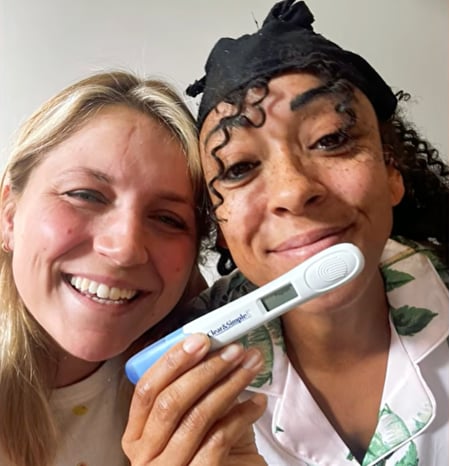
The moment Fran and Jess saw the result they’d been waiting for.
After that, it was amazing, but it was still tricky. When you know people who’ve gone through miscarriages or difficult things along the way, you don’t really want to get your hopes up until you feel like you’re at a safer point. But we were over the moon. We told our family first, and then the symptoms came along, the sickness and tiredness, and you just have to try and look after your body as much as possible because you’re growing a human.
It’s such an emotional whirlwind.
“Oh my God, this is my baby”
I feel like I’m still in that whirlwind now, and Reuben is four months old.
For so long, you know there’s a baby in there. Then when they’re actually here, you’re like, “Oh my God, this is my baby.” It’s this reaction of, “This baby has actually come from my body. How amazing is that?”
There are struggles afterwards too. Your body isn’t the same. That’s probably something I’ve struggled with a little bit more, having played football and being used to my body being lean and strong. But then I look at him and think, “I made him.” And that’s amazing.
The biggest lesson is probably that you have to be patient with yourself. Reuben is a reminder of how amazing the whole journey is. I wouldn’t change it. I know some people don’t get that positive pregnancy, and it can be really tricky, but I’m just so fortunate that our journey worked. I wouldn’t have wanted to do it with anyone else than Care Fertility, and if we have more babies in the future, we’d definitely go with them again.
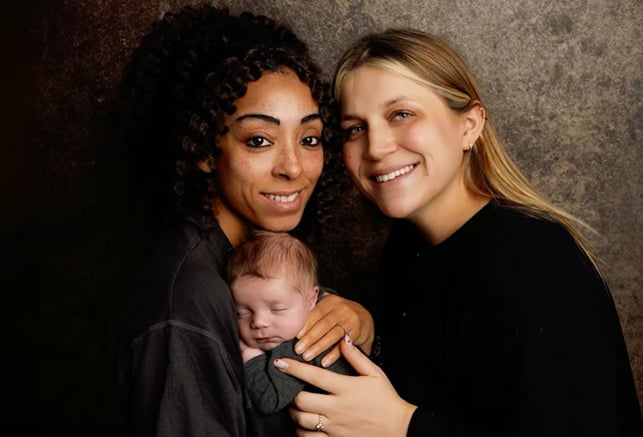
Fran and Jess with Reuben, their little boy, after having fertility treatment at Care Fertility Leeds.
Family planning in football
For me, I’d been in teams where people had had babies and returned. My first club was Chelsea, and Katie Chapman had three boys and came back every single time. That was amazing to see. But personally, I always felt I wanted to retire and then have a baby. I don’t know why, that was just my preference. Once I was ready to stop, I was ready to stop, and that chapter was closed.
But that’s not the case for everybody. Just because someone has a baby, it doesn’t mean they want to stop playing. Players can come back, and you see players who have.
I do think family planning is still a bit of a taboo subject in football. You might talk about it with teammates, but there can be a feeling that if you get pregnant, or if a club knows you want a baby, it might affect whether they offer you another contract. And that’s a valid worry, because contracts in women’s football can be short. Nine months is a long time out of a 12-month contract.
A lot of players say, “I’ll just wait until after football.” But honestly, that could be too late. You don’t know what your body is doing at that time. You don’t know until you’ve had the tests.
That’s why awareness is so important. It’s not about saying everyone needs to have a baby now. It’s about players being able to make an informed decision. Do I need to freeze my eggs? Can I wait? Do I need to look at different types of treatment? Do I need to be looking for a donor?
Especially in the women’s game, where there are a lot of same-sex relationships, some players may have a longer journey. There might be more steps involved. If someone wants to retire in 18 months, could they start looking at those steps now, rather than getting to that point and being stung by, “Oh, we need a donor, and that might take another year?”
Taking the mystery out
For me, that’s the power of the partnership between the PFA and Care Fertility. It gives players information directly. Hopefully it encourages more players to think, “You know what, I’ll pick up the phone and have a chat.”
It’s just taking some of the mystery out and making it a little bit easier. I’d love to hear players talking among themselves and saying, “I had a call with Care Fertility yesterday,” or, “My PFA rep passed me on to Care Fertility.” Players should have the right to know what the process is.
Every time I connect with an old teammate or one of my friends, they’re really intrigued. Some have said, “I’m not planning for a baby right now, but it would be great to know where I’m at, so when I do want a baby, I already know my options.” That’s exactly it. It doesn’t mean you need to start right there and then. It’s about planning in advance.
It’s the same as thinking about what you’re going to do for a career after football. People look at that way ahead. Fertility can run alongside that, so the choice is theirs when the time comes, rather than getting to it and the choice not being there anymore.
And now, people just want to meet Reuben. Everybody loves a baby, don’t they? It’s nice to feel supported by people still in the game, and it’s nice to see how many players do actually want families. Maybe seeing Reuben has made some people realise they want that in the future too. Like, “Wow, she’s done it, so I can do it.”
There’s a whole community of mothers in football, and it’s constantly growing. We’re probably going to have a little five-a-side of babies soon, in the WSL and at the PFA.
Ready to understand your fertility options?
Fran and Jess’ story shows how much clarity can help, whether you’re ready to start treatment now or simply want to understand what might be possible in the future.
Our partnership with the PFA is a continuation of our promise to make everyone feel seen, heard, and supported. For players and patients alike, that means clear, accessible fertility information, expert guidance, and compassionate care, with space to ask questions and make decisions in your own time.
To find out more about fertility testing, treatment options, or planning ahead, contact Care Fertility today. Our team will listen, talk you through your next steps, and help you feel more confident about what comes next.
Click here to get in touch with our team
Watch Fran's story
