
If you’re thinking about egg freezing, one of the first questions that comes up is how many eggs you actually need.
You may have heard that 20 eggs is the ‘golden number’. This isn’t a strict rule, but it’s a helpful guide based on how egg freezing works in practice and what we see in treatment outcomes.
The key thing to understand is that not every egg you collect will lead to a baby. There are several stages where numbers naturally reduce, and this is completely normal.
Quick jump:
Why numbers matter
During ovarian stimulation, your body is encouraged to produce multiple follicles. Each follicle has the potential to contain an egg, but not all of them will.
Some important points to keep in mind:
- Not every follicle contains an egg
- Not every egg collected will be mature
- Not every mature egg will be suitable for freezing
Even in well-managed cycles, this variation is normal. On average, around two-thirds of follicles of a suitable size contain a mature egg.
This is why the number of eggs collected is often lower than the number of follicles seen on scan.
What happens after freezing
Egg freezing uses vitrification, a rapid freezing method that protects the egg.
Around 85% of eggs survive the freeze and thaw process. This is a strong survival rate, but survival alone does not mean those eggs will lead to pregnancy.
After thawing:
- Some eggs will not fertilise
- Some fertilised eggs will not develop into embryos
- Some embryos will not be suitable for transfer
- Some embryos will not implant
- Some embryos will implant, but will not sustain a pregnancy to term
According to the Human Fertilisation and Embryology Authority (HFEA), for women under 35, the chance of having a baby from a thawed egg is around 18% to 30% per egg.
Because of this, having more eggs frozen can improve your overall chances of having a baby in the future.
Why 20 eggs is often recommended
The recommendation of around 20 eggs comes from looking at these drop-offs across each stage.
It gives a balance between:
- The number of eggs needed to create embryos
- The likelihood of at least one embryo leading to a pregnancy
- The possibility of more than one child in the future
It is not a guarantee, but it provides a more reliable starting point when planning ahead.
Not all eggs come from one cycle
For many women, collecting around 20 eggs takes more than one cycle.
Your treatment is always tailored to your body and your safety. We monitor how your ovaries respond to medication and adjust accordingly.
In some cases, especially for women with polycystic ovary syndrome (PCOS), there is a higher risk of ovarian hyperstimulation syndrome (OHSS). This can happen when the ovaries respond too strongly to stimulation.
If there is a risk of OHSS, we may:
- Adjust medication doses
- Collect fewer eggs in a single cycle
- Recommend more than one cycle to reach your target safely
This approach helps protect your health while still working towards a good overall number of eggs.
The role of egg quality
The number of eggs is important, but quality is just as important.
Not all eggs have the same potential to develop into embryos. This is influenced by factors such as age and underlying fertility.
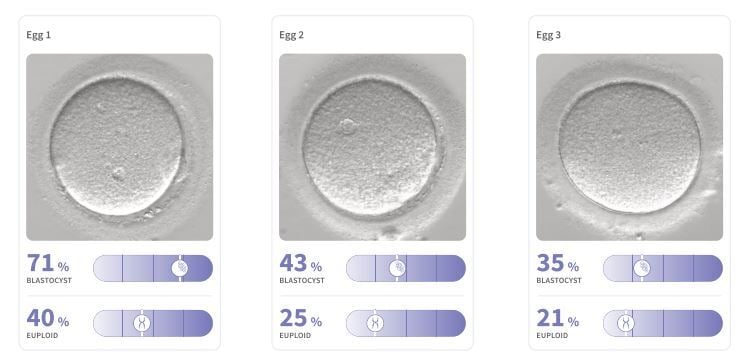
At Care Fertility, we use tools like Violet™, our AI-supported technology, to help assess egg and embryo potential.
This allows us to:
- Identify which eggs are more likely to develop into blastocysts
- Estimate the likelihood of embryos being chromosomally normal (euploid)
This supports more informed decisions about which eggs to freeze and how to plan future treatment.
Age and timing
Your age at the time of egg freezing is one of the most important factors in determining success.
Women are born with all the eggs they will ever have. Over time, both the number and quality of those eggs naturally decline.
At the same time, egg quality also changes. This can affect:
- Fertilisation rates
- Embryo development
- Chances of pregnancy
- The likelihood of chromosomal abnormalities
This is why egg freezing is often more effective at younger ages. Eggs collected earlier are more likely to be healthy, which can reduce the number needed to achieve a pregnancy in the future.
If you freeze eggs later, you may need a higher number to give yourself the same chance of success.
This is also why we always personalise recommendations based on your individual results, including your age, ovarian reserve, and how your body responds to treatment.
What this means for you
The idea of a “golden number” can be helpful, but it should never feel like a target you must reach at all costs.
Some people may achieve their goals with fewer eggs. Others may choose to freeze more, especially if they are planning for more than one child.
The most important step is understanding your current fertility.
At Care Fertility, we begin with assessing your fertility. This includes blood tests and a scan, so that when you speak with a doctor, your results are already available to guide the conversation.
After your consultation:
- You will receive a personalised summary, including treatment options and costs, through your companion treatment app, Salve
- You will complete screening tests and consent forms before treatment
- You will have a treatment planning discussion with a nurse before starting medication
We guide you through each stage, so you feel informed and supported throughout.
Final thoughts
Egg freezing is about giving yourself options for the future, not chasing a perfect number.
Aiming for around 20 eggs can improve your chances of having a baby later on, but it is only part of the picture. Your age, egg quality, and how your body responds to treatment all play an important role in shaping what is right for you.
That is why starting with a clear understanding of your fertility can make all the difference. With the right information, you can make decisions that feel considered and right for your timeline.
If you are thinking about egg freezing, we are here to support you.
You can call our team on 0800 564 2270 to talk things through or get in touch by clicking here to take the first step.